Why Your Dinner Is Boring (And It Has Nothing to Do With Flavor)
Let's be honest about something. You could season your chicken perfectly, nail your sauce, use the freshest vegetables from the Saturday farmers market—and the meal can still fall flat. Not because anything tasted bad. But because every single bite felt exactly the same.
This is the texture problem, and American home cooking has a serious case of it.
In Hong Kong kitchens—both professional and home—the question of how food feels in the mouth is treated with the same seriousness as how it tastes. It's not an afterthought. It's part of the design. And once you start cooking with texture contrast as a deliberate goal, you'll understand why so many dishes from that culinary tradition feel so satisfying in a way that's hard to articulate but impossible to ignore.
The Philosophy Behind the Crunch
Hong Kong's culinary culture draws from Cantonese cooking traditions that have spent centuries refining the concept of hau gam—literally, mouth feel. The idea that the physical experience of eating is part of the pleasure isn't a new food science discovery. It's embedded in the way Hong Kong cooks think about putting a meal together.
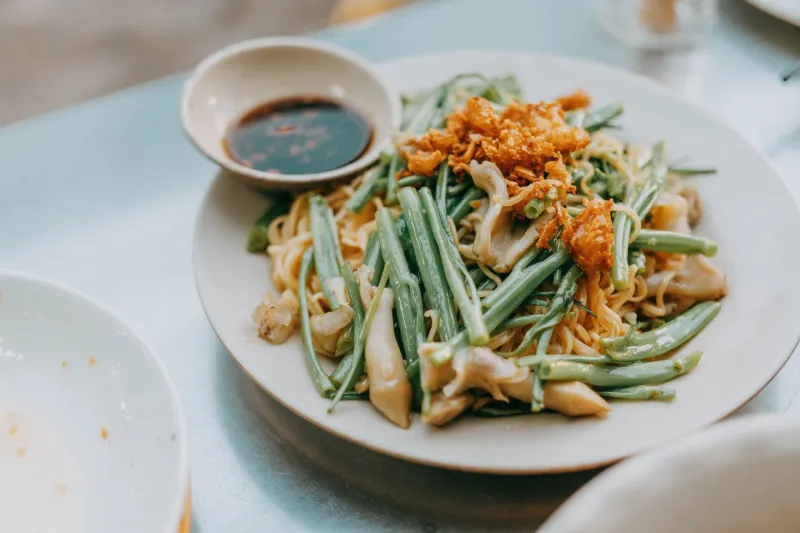
Walk into a Hong Kong cha chaan teng and order a plate of pan-fried noodles. What arrives is a study in deliberate contrast: a crispy, lacy exterior of noodles that shatters slightly on first contact, giving way to a softer, chewier interior, topped with tender sliced beef and silky vegetables. Every component is doing something different in your mouth. The result isn't just filling—it's genuinely exciting to eat.
Or consider a simple bowl of wonton noodle soup. The broth is clear and clean. The wontons are soft and yielding. The noodles are springy and slightly resistant. And often, there's a scattering of something crispy on top—fried shallots, a handful of toasted sesame seeds, a few slivers of deep-fried garlic. That contrast isn't decorative. It's structural.
Where American Cooking Goes Sideways
The default texture in American home cooking tends to be... soft. Braised everything. Slow-cooked everything. Roasted until tender. Creamy soups, mashed sides, casseroles where every element has merged into a uniform, comforting mass.
None of that is wrong, exactly. Comfort food is comfort food for a reason. But when soft becomes the default every night, meals start blurring together. You eat, you're full, you don't think about it again. That's fine for fuel. It's not particularly memorable as an experience.
The fix isn't complicated. It doesn't require new equipment or advanced technique. It requires one additional question at the end of every meal you're building: What's providing the contrast here?
The Hong Kong Toolkit for Texture
The good news is that the tools Hong Kong cooks use to build texture contrast are mostly simple, inexpensive, and already available at any grocery store.
Fried shallots are the single highest-impact addition you're probably not making. You can buy them pre-fried in bags at Asian grocery stores (look near the condiments section), or make them yourself in about ten minutes with thinly sliced shallots and neutral oil. Scatter them over rice dishes, soups, noodles, roasted vegetables, or salads. They add crunch, sweetness, and a savory depth that transforms the dish around them.
Toasted nuts and seeds work on the same principle. Toasted sesame seeds, roughly chopped roasted peanuts, or slivered almonds added to a stir-fry or grain bowl at the last moment provide a textural counterpoint to softer elements without changing the flavor profile significantly.
Quick-pickled vegetables are a Hong Kong kitchen staple that American cooks are slowly catching on to. A five-minute pickle—thin cucumber slices or shredded daikon in a mixture of rice vinegar, sugar, and salt—adds both crunch and acidity to cut through rich or fatty dishes. It's the textural reset button on a plate.
Crispy skin and caramelized edges are celebrated in Hong Kong cooking in a way they sometimes aren't in American preparations. Char siu pork is prized for its lacquered, slightly chewy exterior. Roast goose is judged by the crackle of its skin. Pan-fried tofu gets pressed and cooked until golden and firm on the outside, creamy within. The lesson: don't rush past the browning. That's where the texture lives.
Chewy noodles and springy proteins round out the toolkit. Hong Kong-style egg noodles, made with alkaline water, have a distinctive bounce that sets them apart from softer Italian pastas. Shrimp in Hong Kong preparations are often treated with baking soda to enhance their snap. These aren't exotic techniques—they're simple interventions that prioritize the physical experience of eating.
Building a Textured Plate: A Practical Framework
You don't need to reconstruct your entire approach to cooking. You just need to start asking a slightly different question when you're plating.
Think in three texture categories: something soft or tender, something chewy or substantial, something crispy or crunchy. That's it. Not every dish needs all three. But reaching for at least two, deliberately, will change how your meals feel.
A simple weeknight rice bowl might have tender braised chicken (soft), steamed rice (substantial), and fried shallots plus a quick cucumber pickle (crispy and fresh). A pasta dish might get a handful of toasted breadcrumbs and some sautéed greens with crispy edges alongside the silky noodles.
None of this requires extra hours in the kitchen. Most texture additions take under five minutes. The investment is almost entirely mental—a shift in how you think about what a complete dish actually means.
The Bigger Point
Hong Kong's obsession with texture isn't arbitrary. It reflects a culinary culture that takes eating seriously as a sensory experience, not just a caloric transaction. When you eat something that plays with contrast—that surprises your mouth slightly with each bite—you pay attention differently. The meal slows down. You notice what you're eating.
That's worth something, especially in a food culture that increasingly eats at desks and over phones. A little crunch can bring you back to the table.